What Partners in Gaming Really Means for Your Next Creative Project
When you first encounter a design bundle labeled Partners in Gaming, you might expect something narrow—a logo, a badge, maybe a single graphic concept. What you actually get is more nuanced and, for the right person, considerably more useful. This is a multi-format asset package built around the visual language of gaming culture, collaborative play, and the kind of shared experience that defines modern streaming, esports, and community-driven entertainment. It lands somewhere between a branding shortcut and a creative springboard, and understanding where it fits in your workflow can save you hours of trial and error.
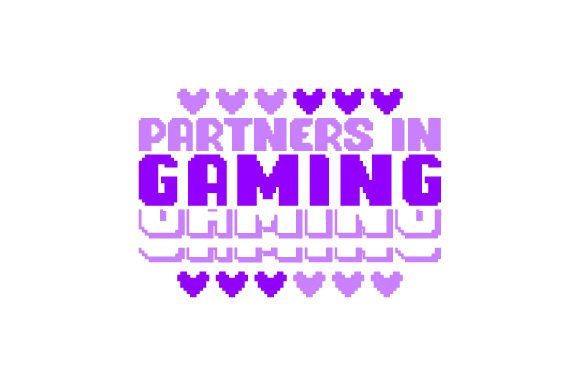
The core offering revolves around the Partners In Gaming wordmark and symbolic elements designed to signal alliance, teamwork, and competitive camaraderie. The phrase itself carries weight across multiple niches—content creation teams, tournament organizers, game development studios, merchandise designers, and even educators building gamified learning platforms. The visual assets are not just decorative. They are structured to be placed on stream overlays, apparel, social media banners, promotional materials, and product packaging without requiring you to redraw or reinterpret the core message.
The Practical Anatomy of a Multi-Format Design Asset
What separates a forgettable graphic from a genuinely useful design resource often comes down to file architecture. The Partners in Gaming bundle arrives in four distinct formats: SVG, Transparent PNG, EPS, and DXF. Each serves a different production reality, and recognizing that difference determines how far you can stretch the original artwork.
SVG files are the backbone of digital adaptability. They scale without degradation, which means the same graphic that sits cleanly on a mobile-responsive website header can expand to fit a large-format display without introducing pixelation or soft edges. For web developers, app interface designers, and anyone building digital dashboards for gaming communities, this format is non-negotiable. The code-level cleanliness of a well-structured SVG also makes it easier to animate individual elements if you plan to use motion graphics.
Transparent PNGs solve a different problem. When you need immediate drop-in capability—overlaying a graphic on a Twitch stream without a background box, placing it on merchandise mockups, or layering it onto video content—the PNG with alpha transparency removes friction. You are not masking, you are not blending. You position and move on. For creators who cycle through assets rapidly, this format reduces the time between concept and publish.
The EPS file targets print production. If you intend to produce banners, signage, or any physical collateral through a professional print service, EPS remains the industry handshake. It preserves vector paths and color information in a way that commercial printers can interpret without back-and-forth clarification. This matters when color accuracy and crisp edges are non-negotiable, especially for event materials or branded booth graphics.
Then there is DXF, the format most general design bundles omit. DXF files communicate with cutting machines—vinyl cutters, laser engravers, CNC routers. If you want to etch the Partners In Gaming mark onto a metal plaque, cut it from adhesive vinyl for a custom arcade cabinet, or create dimensional signage, this format turns a digital concept into physical reality. Its presence signals that the designer considered fabrication, not just screen display.
Assessing Quality and Visual Consistency
Evaluating the actual construction of the artwork requires looking beyond the preview render. In practical use, the Partners in Gaming graphics exhibit clean line work with intentional spacing that survives scaling tests. The typography within the wordmark avoids the common pitfall of overly thin strokes that vanish at small sizes or bleed together when inverted on dark backgrounds. Testing across mockups—from a small mobile esports banner to a stretched stream overlay—the legibility holds, which suggests the original vector nodes were placed with production in mind, not just presentation.
Color handling deserves attention. The primary palette often leans into bold contrasts—vibrant accents against darker foundations—which aligns with the visual expectations of gaming culture. However, because the files arrive as editable vectors, you are never locked into the default scheme. Recoloring to match brand guidelines, sponsor requirements, or seasonal campaigns is straightforward in any vector editing application. This flexibility transforms the asset from a single-use graphic into an adaptable component of a broader visual system.
One observation worth noting: the designs assume a certain density. They work best when given breathing room. Crowding them with competing visuals, overly complex backgrounds, or clashing typography dilutes their impact. The strongest implementations treat the Partners In Gaming mark as a focal element rather than a supporting decoration. This is not a flaw so much as a characteristic—understanding it helps you avoid layout decisions that undercut the asset's strength.
Who Gains the Most from This Resource
The obvious audience includes streamers and content creators building recognizable channel identities. But the usefulness extends further than you might initially guess. Below are the groups I have observed benefiting most directly from well-structured gaming-themed design assets like this one.
- Esports organizers and tournament administrators who need consistent branding across brackets, overlays, social promotion, and venue signage. The format variety means the same core identity can appear on screen, on print, and on physical installations without version-control headaches.
- Merchandise designers and print-on-demand entrepreneurs looking for gaming-aligned graphics that are legally clean to apply to apparel, accessories, and print products. The DXF inclusion is rare and valuable here, enabling physical goods beyond screen printing.
- Small game studios and indie developers who require promotional assets, partnership announcements, or community event branding without commissioning custom illustration from scratch. The adaptable framework lets them maintain visual coherence while iterating quickly.
- Educators and workshop facilitators using gamification in learning environments. The visual language of gaming partnership can frame collaborative activities, team challenges, and reward systems in a way that resonates with students familiar with gaming culture.
- Freelance designers and marketers who serve gaming-adjacent clients and need reliable base assets that reduce production time while still allowing room for customization and client-specific adaptation.
Real-World Scenarios Where the Assets Excel
Consider a mid-sized content creation group launching a new collaborative channel. They need overlay graphics, merchandise proofs, social media templates, and physical stickers for a launch event—all bearing the same core identity. Starting from scratch, the design workload is heavy. With a structured Partners in Gaming bundle, the designer can pull the SVG into Figma or Illustrator for screen layouts, drop the PNG into a stream overlay in OBS, send the EPS to a print shop for banners, and load the DXF into a vinyl cutter for logo decals. The time saved is cumulative and meaningful.
Another example: an educator running a semester-long gamified classroom experience. The teacher wants team logos, progress board decorations, and printable reward tokens. The transparent PNG files drop directly into presentation software and worksheet designs. The DXF files allow cutting physical badges from adhesive vinyl using a classroom cutter, turning a purely digital concept into something tactile. The consistency across touchpoints reinforces the program structure without requiring the educator to become a graphic designer.
Potential Limitations and Professional Considerations
No design asset is universal, and Partners in Gaming is no exception. The style tends toward a specific aesthetic—bold, energetic, and unmistakably tied to gaming culture. If your brand identity leans minimalist, corporate, or subdued, the default aesthetic may require significant modification to align. You can recolor and simplify, but the core typographic structure and symbolic weight remain. This is not a neutral, transparent template; it is a designed statement. Evaluating whether that statement fits your audience before committing prevents misalignment.
Additionally, while the file formats cover a broad production spectrum, they assume you possess the software to open and manipulate them. SVG, EPS, and DXF are not as universally double-clickable as JPEG or PNG. Users unfamiliar with vector editing applications or CNC software preparation may face a learning curve. The value is highest when your workflow already accommodates these formats; if you need to acquire new tools or skills, factor that into your time calculation.
Another practical note concerns usage rights. Multi-format design bundles often come with license terms that dictate how the artwork may be applied—especially regarding merchandise resale, trademark incorporation, or redistribution as standalone files. Before integrating the Partners In Gaming assets into commercial products or client projects, confirming the specific license scope protects you from downstream complications. This is not unique to this bundle, but it is a professional habit worth maintaining.
Integrating the Assets into a Long-Term Workflow
The long-term value of any design resource hinges on how well it ages with your projects. A graphic that looks sharp in year one but feels dated by year three creates a cycle of redesign you may not have budgeted for. The Partners In Gaming visual language draws from gaming culture motifs that have shown staying power—team dynamics, competitive spirit, shared achievement—without leaning too heavily on transient meme culture or platform-specific references that date quickly.
From a workflow perspective, keeping a master folder of such assets organized by format and color variant turns them into a reusable library rather than a one-off download. When a new project or collaboration opportunity arises, you can pull the appropriate file type, adapt the colors and scale to fit the context, and maintain brand continuity without starting from a blank canvas each time. This approach compounds the initial value over months and years of use.
For agencies and freelancers serving multiple gaming clients, the efficiency argument strengthens. The asset becomes a modular block that can be reconfigured per client while preserving the structural quality of the original artwork. One client needs a dark-themed version for an overlay; another needs a bright, recolorized adaptation for merchandise. Both derive from the same root file, saving billable hours and maintaining output consistency.
Making an Informed Decision
When you strip away the enthusiasm that often surrounds gaming-themed design products, the practical question remains: does this fill a genuine gap in your production pipeline? If you regularly create content, products, or experiences around collaborative gaming, team competition, or community-driven play, the Partners in Gaming bundle provides a solid foundation that reduces repetitive design labor. The inclusion of production-ready formats—especially DXF—extends its usefulness beyond purely digital applications, which is comparatively rare at typical bundle pricing.
If your work only occasionally brushes against gaming culture, or if your audience expects highly customized, bespoke visuals that cannot share recognizable DNA with other brands, you might use the assets sparingly or as reference material rather than direct implementation. Neither path is wrong; clarity about your needs simply leads to better resource allocation.
The strongest endorsement I can offer is observational: among the designers and content creators I have seen adopt this type of asset, the ones who benefit most are those who treat it as a starting point, not a finished product. They recolor, rescale, recombine, and push the artwork into contexts the original designer may not have envisioned. The file formats support that exploration. Whether your next step is a stream overlay, a team jersey, a vinyl decal, or an event banner, having the artwork structured for production from the start removes invisible friction that adds up fast across multiple projects.