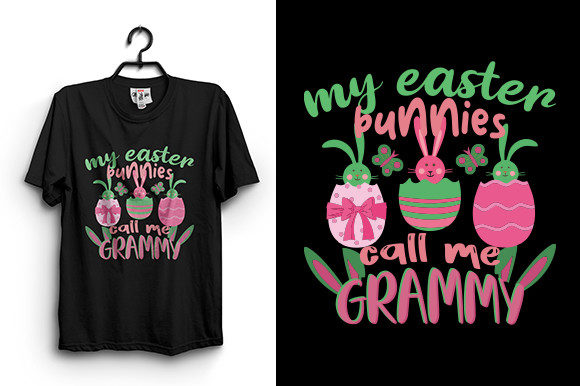
Why "My Easter Bunnies Call Me Grammy" Is More Than Just a Seasonal T-Shirt
There's something quietly powerful about a grandmother pulling on a tee that announces her favorite title to the world. The "My Easter Bunnies Call Me Grammy" T-shirt belongs to a broader cultural shift where personal identity, family bonds, and wearable art converge. It's not simply cotton and ink. It's a declaration, a conversation starter, and for many women, a badge of honor worn close to the heart.
But behind every clever phrase and pastel-hued graphic lies a creative T-shirt design store ecosystem that most shoppers never see. Understanding how these designs come to life, what separates a professional product from a hobbyist upload, and why file quality matters can transform how you buy, gift, and even create custom apparel. This article walks through that world, using the Grammy Easter bunny design as our anchor point.
The Rise of Identity-Driven Apparel for Grandparents
Grandparent nicknames have evolved dramatically over the past two decades. Gone are the days when "Grandma" and "Grandpa" were the only options on the table. Modern families embrace names like Mimi, Nana, Pops, Gigi, and of course, Grammy. Each name carries its own personality, regional flavor, or family story. When a grandparent chooses to wear that name on a shirt, they're participating in a form of self-expression that older generations rarely had access to.
Seasonal variations add another layer. An Easter-themed Grammy shirt connects two things that matter deeply to many older adults: faith traditions and family togetherness. The Easter bunny motif softens the design, making it playful and approachable for community egg hunts, church gatherings, or brunch with the little ones. It signals warmth, approachability, and a willingness to be silly for the sake of the grandchildren.
From a sociological perspective, these shirts also serve as social signals. When a woman wears "My Easter Bunnies Call Me Grammy" at a spring festival, she's instantly identifiable to other grandparents, to families with young children, and to anyone who appreciates the grandparent-grandchild bond. It breaks down barriers and invites smiles from strangers—a small but meaningful form of community building.
What Makes a Professional T-Shirt Design Different
Not all graphic tees are created equal, and the difference often comes down to what happens long before the shirt hits the press. A creative T-shirt design store that operates professionally invests in file formats, resolution standards, and organizational systems that casual sellers might overlook.
Vector Graphics vs. Raster Images: Why It Matters
If you've ever tried to enlarge a low-quality image and watched it dissolve into pixelated chaos, you've encountered a raster file pushed beyond its limits. Professional T-shirt designs are built as 100% vector artwork, which means the image is constructed using mathematical paths rather than fixed pixels. You can scale a vector design to the size of a billboard or shrink it to fit a baby onesie without losing a single crisp edge.
The Grammy Easter bunny design referenced in this store comes in multiple vector-compatible formats: AI (Adobe Illustrator), EPS, and SVG. These aren't just alphabet soup—each serves a distinct purpose. AI files preserve full editability for designers who use Illustrator. EPS acts as a universal exchange format that works across different software ecosystems. SVG is the web-friendly vector standard that also plays nicely with cutting machines like Cricut and Silhouette, opening up possibilities beyond just T-shirts.
The 300 DPI Standard and What 4500×5400 Pixels Actually Means
Print professionals live by the 300 DPI (dots per inch) rule. Anything lower, and the human eye begins to perceive blurriness or jagged edges in the final printed product. A design delivered at 4500×5400 pixels at 300 DPI translates to a physical print area of 15×18 inches—ample room for most apparel applications including full-front chest prints, back designs, and even oversized statement placements.
This resolution also future-proofs the design. If a print shop needs to scale the artwork slightly for a plus-size garment or adjust positioning for a hoodie pocket, they have enough pixel real estate to work with. Cheap, low-resolution files box printers into corners. Professional files give them creative and technical freedom.
Inside a Well-Organized Creative T-Shirt Design Store
The phrase "Files well organized" might sound like a minor bullet point, but for anyone who has downloaded a jumbled mess of design assets, it's a lifeline. A properly structured download package typically includes clearly named folders separating file types, a preview image for quick reference, and sometimes a simple README or usage guide.
Here's what a thoughtful ZIP file delivery might contain:
- Vector editable files – AI and EPS formats for designers who need to change colors, add text, or modify elements
- Web and preview formats – High-quality PNG at 300 DPI for mockups and digital sharing
- Universal vector format – SVG for compatibility with cutting machines and a wide range of software
- Color variations – Black, white, or full-color versions depending on garment choices
- Preview or thumbnail image – So you can see the design at a glance without opening heavy files
This organizational discipline reflects a deeper truth about the creative T-shirt design market: the best stores treat their customers as collaborators, not just consumers. When someone buys a design, they're often planning to use it across multiple items—perhaps a shirt for Grammy, a matching onesie for the grandchild, a tote bag for Easter basket deliveries, and a mug for the kitchen counter. Easy file access makes that creative freedom possible.
Black, White, or Color: The Versatility Question
One of the most practical selling points in the "My Easter Bunnies Call Me Grammy" design listing is the availability of black, white, or color versions. This isn't just a convenience feature—it's an acknowledgment of how diverse print scenarios actually work.
Consider the garment color. A design that looks stunning in full pastel color on a white T-shirt might disappear entirely on a navy blue hoodie. A black-only version of the same artwork, however, could pop beautifully on light heather gray or soft pink. White versions work magic on dark backgrounds. Offering these variations means the design adapts to the substrate rather than forcing the buyer to compromise.
For heat transfer vinyl (HTV) users, this is especially critical. Many crafters work with single-color vinyl rolls—black, white, gold, or glitter. Having a clean single-color version of the design eliminates the headache of manually separating colors or tracing artwork. It's ready to cut, weed, and press the moment it's downloaded.
The Broader Creative Economy and Print-on-Demand Culture
Understanding a single T-shirt design opens a window into the print-on-demand (POD) ecosystem that has reshaped e-commerce over the past decade. Platforms like Etsy, Shopify stores, and creative marketplaces have enabled independent designers to sell directly to consumers who either print the designs themselves or use POD fulfillment services.
This democratization of apparel design has had several ripple effects:
- Niche communities are better served. A grandmother who adores Easter and her grandkids can find a shirt that speaks precisely to her identity, rather than settling for generic seasonal graphics at big-box retailers.
- Small-batch and one-off production reduces waste. Traditional apparel manufacturing relies on bulk orders and inventory speculation. POD produces items only when purchased, which aligns with more sustainable consumption patterns.
- Designers retain creative control and earn directly. Instead of selling designs to corporations for flat fees, independent artists can build businesses around their portfolios.
The "My Easter Bunnies Call Me Grammy" design sits at the intersection of these trends. It's a targeted, emotionally resonant concept that would be difficult to find in a physical store's limited shelf space, but thrives in the long tail of online retail.
Common Misunderstandings About Digital T-Shirt Design Purchases
First-time buyers of digital design files often bring assumptions that don't match reality. Clarifying a few of these can save frustration and help customers make informed decisions.
Misunderstanding #1: "I can edit anything if I have the file." While professional designs include editable formats, actually editing them requires software like Adobe Illustrator, CorelDRAW, or Affinity Designer, plus some working knowledge of vector editing. The files are fully editable for those with the tools and skills, but they're not magically self-modifying.
Misunderstanding #2: "One file works for everything." Different printing methods—screen printing, direct-to-garment (DTG), sublimation, heat transfer vinyl, embroidery digitizing—have different file requirements. A well-organized download package anticipates this by providing multiple formats, but the user still needs to match the right file to their chosen method.
Misunderstanding #3: "Resolution numbers are just marketing hype." They're genuinely not. Try sending a 72 DPI web image to a screen printer and you'll quickly understand why 300 DPI at substantial pixel dimensions matters. The numbers translate directly to physical print quality.
Why "Easily Changed Without Losing Any Quality" Is a Meaningful Promise
The product description emphasizes that the design can be "easily changed without losing any quality," and this speaks directly to the vector advantage. If a customer wants to replace "Grammy" with "Nana," "Mimi," or "Grandma," a vector file allows that text edit in seconds. The surrounding artwork—the bunny ears, the decorative elements, the composition—remains razor-sharp because nothing is being stretched or interpolated.
This editability also matters for color adjustments. Perhaps the original pastel palette doesn't match a family's Easter brunch aesthetic. With the AI or EPS file, recoloring is straightforward. The design adapts to the user's vision rather than demanding the user adapt to the design.
Practical Applications Beyond the Obvious
While the T-shirt is the star of this design, the same artwork can migrate to surprising places once it's in a customer's hands:
- Easter basket liners or fabric prints – Print the design on fabric to create custom basket accessories
- Framed wall art for a nursery or grandchild's room – A high-resolution print on quality paper becomes a sentimental gift
- Greeting cards or Easter party invitations – Scaled down and paired with text, the illustration anchors themed stationery
- Aprons for Easter cookie baking – Heat transfer the design onto a kitchen apron for festive baking sessions
- Digital scrapbooking elements – The PNG file integrates into digital memory books documenting Easter celebrations
These extended applications highlight why purchasing a well-organized design file bundle offers value that a single pre-printed shirt never could. The initial investment multiplies across projects and years.
How to Evaluate a Creative T-Shirt Design Store Before Buying
Not every storefront offering T-shirt designs operates with the same standards. Here are several factors worth examining before clicking the purchase button:
- File format transparency – Does the listing clearly state which formats are included? Vague language like "print-ready files" without specifics is a red flag.
- Resolution and dimension details – Look for concrete numbers like 300 DPI and pixel dimensions, not just "high quality" claims.
- Vector confirmation – If you might ever resize the design, confirm that true vector files (AI, EPS, SVG) are part of the package.
- Preview accuracy – Does the preview image accurately represent the design, or does it rely heavily on mockup effects that might conceal flaws?
- Seller responsiveness – A statement like "Please let me know if you have any more inquiries, I'll be happy to help" indicates a seller who stands behind their work and welcomes questions.
The Emotional Core of a Seasonal Grandparent Design
Stepping back from technical specifications, there's a reason designs like "My Easter Bunnies Call Me Grammy" resonate so deeply. They sit at the intersection of identity, seasonality, and love. Wearing this shirt isn't just about celebrating Easter—it's about publicly claiming a relationship that matters. It's about telling the world, and perhaps reminding oneself, that being a grandmother is a central part of who you are.
For the grandchildren who see Grammy wearing this shirt year after year at Easter gatherings, it becomes part of their memory architecture. The design embeds itself into family tradition, gaining sentimental weight with each passing spring. That's something a generic seasonal shirt from a department store rarely achieves.
The creative professionals who design these pieces understand this emotional landscape. They're not just arranging clip art and choosing fonts. They're crafting visual shorthand for complex family feelings—pride, tenderness, playfulness, belonging. When the design is well-executed and the files are professionally prepared, that emotional intention survives the journey from digital canvas to physical garment without degradation.
Embracing the Full Value of What You're Purchasing
When you buy a design like the Grammy Easter bunny T-shirt artwork, you're acquiring more than an image. You're getting a professionally structured product that includes editability, scalability, multi-format versatility, and the freedom to apply it across countless personal projects. The single ZIP file containing AI, EPS, PNG, and SVG formats represents hours of design work, file optimization, and organizational care.
For crafters, small business owners, and gift-givers alike, understanding this fuller picture changes the purchasing calculus. It's not just about the cute bunny graphic or the clever phrase. It's about the creative possibilities that professional file delivery unlocks, and the family memories that those possibilities help create.
Whether you're printing one shirt for yourself, creating matching family Easter outfits, or building a small product line around seasonal grandparent designs, the foundation is the same: quality artwork, delivered properly, ready to perform across any medium you choose. That's what separates a genuine creative T-shirt design store from the noise, and it's what makes a design like "My Easter Bunnies Call Me Grammy" worth far more than its price tag suggests.